Tuesday, April 22, 2014

Road Trip in the American Southwest // #1: Jerome Ghost Town

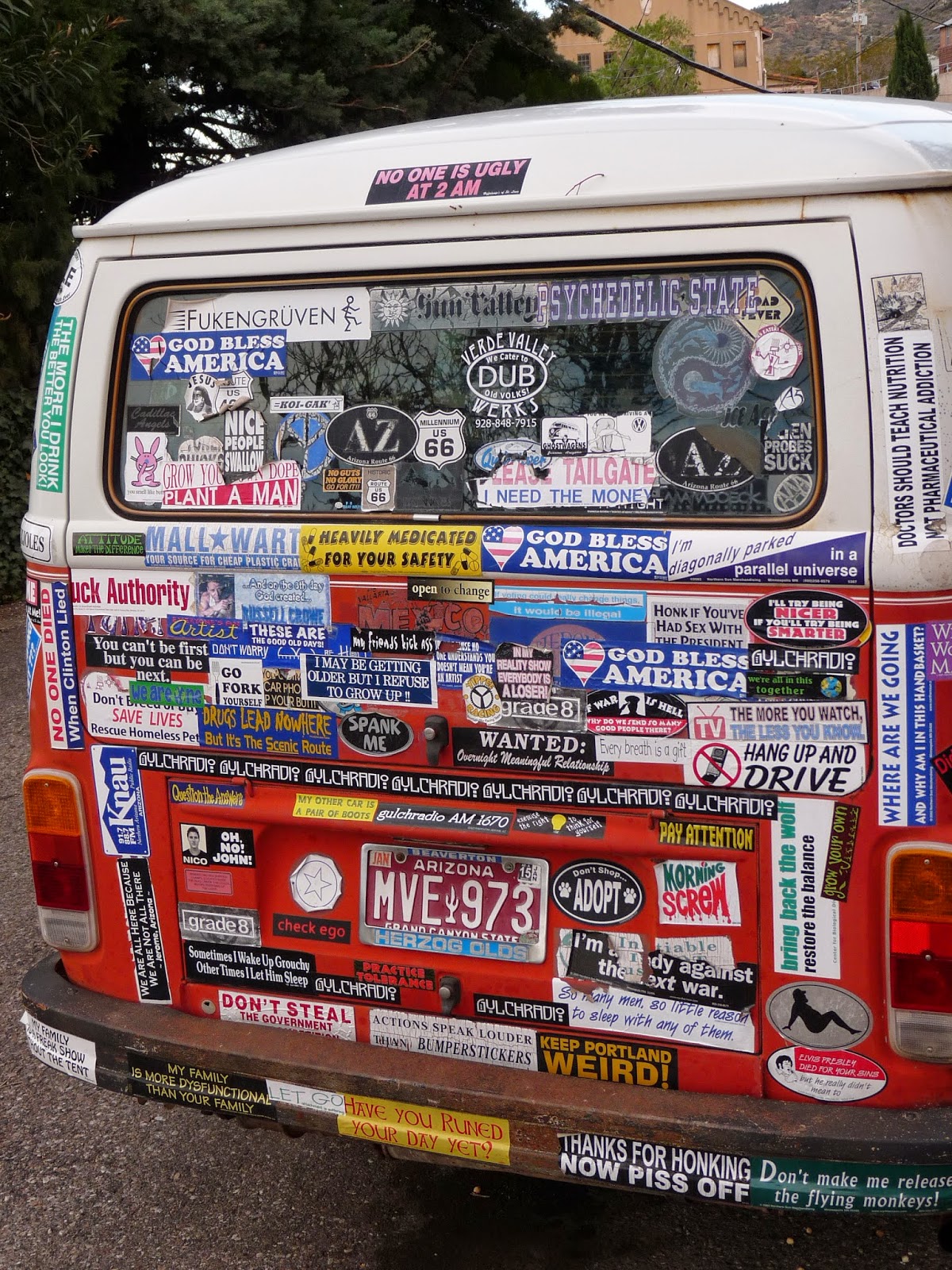
We started our trip from Phoenix, Arizona. As soon as we landed and got our rental car, we quickly got out of this ugly stifling urban area in the middle of the desert, and headed north on Road 17. It is already well past noon so we don't have much time to spare. We have to spend the night in Flagstaff, about two hours away. But on the way there we want to make a detour via the old mining town of Jerome and get a view of Sedona landscapes, which makes us go through smaller roads and will require more time.  


Jerome is a tiny village, 5,200 feet high, that barely appears on maps. It is located northeast of Prescott and southwest of Sedona, next to the villages of Clarkdale and Cottonwood. From Clarkdale, we take road 89A, which climbs pretty stiffly, and after a short ascent we enter what is the biggest ghost town in the US. This old mining camp was built on the biggest copper mine in Arizona. First it was only a settlement of tents but then grew into a roaring mining community. 


The town was founded in 1876 and once was the biggest city in Arizona. Population reached 15,000 in 1920. Mining operations slowed down during the Depression but took off again during WWII because of the high demand in copper. Following the war, it declined for good and the mine was closed in 1953. The remaining 50 to 100 inhabitants promoted Jerome as a historic ghost town. It now has become an artist community with a population of about 450. It almost looks like the way it used to a hundred years ago, although some buildings have been renovated. Others have simply felt down the mountainside. Considering the stiff slope that is not too surprising.


When wandering the streets by feet, one can find a few art galleries, antique shops, pottery and hand made jewelry boutiques, a few restaurants and bars, and here and there out in the street, random bizarre attractions that make for an original atmosphere. 


Thursday, April 3, 2014

Why I love the dentist in America

As a lot of people I guess, I've always been scared of going to the dentist. As a kid or a teenager, every trip to the dentist meant I'd get to subject myself to the drill. Painful memory... What I've only figured out since I live in the United States, is that my french dentist (like all the other ones? I don't know) actually had somewhat barbaric methods! Drilling without anesthesia does not exist any more in the US guys!! Needless to say, it's bound to change your life! 

So here is the story. The first time I went to the dentist in America was because I had received a good deal for a check up and whitening. Since back then I did not have any dental insurance, and because honestly, I could barely remember my last visit to the dentist in France, it seemed to be a bargain. Additionally, teeth whitening may be a common thing here in the US, but it is definitely not in France. I had never done it so it was cool. I figured I might finally get my dream white american smile. Well, it kinda happened... Only, even though I thought I had a pretty decent set of teeth, I ended up with a not so joyful diagnosis: cavities at every corner of my mouth, cost estimate to repair the damage: a little over $1000. Even with whiter teeth, it put a damper on my excitement right away. 

As a result I'm quite familiar with the dentist now. But it's a far more pleasant experience than anything I could remember! It doesn't even hurt! Never! I almost hop and hum on my way there, seriously! Plus after they clean, scratch, scour, and polish your teeth at each visit, they give you a little gift bag with toothbrush, floss and toothpaste! They sure want to entice you to come back to visit them! In the end, maybe I have a shitty health insurance, but I get a free check up, scaling and polishing every 6 months... Go figure. 


Actually Americans are a little obsessive about dental hygiene... First thing the hygienist asks you right after you opened your mouth: "Are you flossing every day?" So at that point honestly... awkwardness... You end up spinning the truth to not seem too filthy... (Because French people already have a bad enough reputation when it comes to hygiene...) Then the dentist shows up, and he makes you damned ashamed again: "Wow they still do silver fillings in France?!" - Ok got it, my teeth are really gross I guess. Luckily, over time, after a few visits to the dentist and a few visits in the supermarkets dental care aisles, "the american smile" is not a secret for you anymore! Now I only need to actually do everything the lady said...


"A smile is to the Americans what a handshake is to the French: a sign of welcome and courtesy." (JJ Dupuis)


Tuesday, March 18, 2014

5 reasons why Americans hate the French

As I promised, after listing the few major stuff French people don't like about Americans, here are the few reasons why Americans talk shit about us. Once again, these are generalities. Plus almost all of the following cliches actually come from old british bias... No wonder Brits and French have never been friends ever in history.

French people are effeminate 
First cliche that comes straight from the English... During the 16th century, they were ridiculing the french language because they found it too delicate, too charming. (Personally I think we don't really have to worry about this since about every english speaking person will tell you that French sounds the sexiest.) 
What's noteworthy though, is that the way american men are educated minimize or eliminate their feminine side because it's considered a weakness. Men are often worried about not looking manly enough. French men dress differently and American men find that very weird. I stopped counting the number of times I've heard jokes about man purses. American men would rather die than wear that kind of accessories, which they consider gay looking. 

French people are cowards
On top of being effeminate, French people are sissies. From what I've read, it's an idea that came up because of the collaboration with the Nazis during WW2. And the caricature got stronger when we opposed Irak invasion. In an episod of The Simpsons, we are even called cheese eating surrender monkeys. Ask any American, he'll know what you're talking about. 

French people are elitists
Basically we're snobs, at least our leading elite is, and has been since Louis XIV proclaimed: "I am the State." The fact that most of our senior officials and executives graduate from the same Grandes Ecoles is considered inappropriate in America. It is even dreaded, because in their opinion, this system only perpetuates a class of arrogant, narrow-minded and incompetent leaders. BAM! When an american political figure knows how to speak french, he purposely avoids to show it at the risk of being accused of elitism. And in politics around here, there's pretty much nothing worse! By the way, the average French person gets his share too:  he has the bad reputation to be haughty and pretentious... 

French people are too theoretical
French people think in a much more abstract way than anglo-saxons and prefer theory to practice. It's a fact, and it's an incomprehensible concept for an American person. Also, the french system is very academic, and for a small but loud and powerful category of Americans, being too educated is considered pretentious.

French people are too collectivists 
Don't fool around with the american ideal of individualism and (individual) pursuit of happiness. Because in the american culture people are an individual entity, the ethic is "to each their own problem". While in other civilized countries people don't perceive themselves as individual and solitaries entities but as members of a group, where everyone is part of a whole. Which is why we help the ones in needs more than in the US, and it's why we don't feel like killing the others as much either. We're raised with a higher sense of solidarity so it's just harder to come down to the decision to kill. In politics, french socialism is very frowned upon and is easily  assimilated to communism, which is the worse thing ever for an American.   

To wrap that up on a better note, I'll add that most Americans like France and the French, for our language, gastronomy, culture, architecture, etc...  From my own experience, they admire us more than they hate us, or they find us too cute... So, oh well...

Thursday, March 6, 2014

Happy Mardi Gras!


Mardi Gras History
It's because of the french and spanish catholic influences that Mardi Gras is celebrated in the southern states of the US. New Orleans is the most well-known place to celebrate it but there are the same traditions in cities of Alabama, Mississippi, and all the way to Pensacola, Florida. On March 2, 1699, the day before Mardi Gras, French-Canadian explorer Jean Baptiste Le Moyne Sieur de Bienville arrived at a plot of ground 60 miles directly south of New Orleans, and named it "Pointe du Mardi Gras". He established New Orleans in 1718, and by the 1730s, Mardi Gras was celebrated openly in the city. In the early 1740s, Louisiana's governor, the Marquis de Vaudreuil, established elegant society balls, which became the model for the New Orleans Mardi Gras balls of today. The earliest reference to Mardi Gras "Carnival" appears in 1781. That year, the first of hundreds of clubs and carnival organizations formed in New Orleans. By the late 1830s, New Orleans held street processions of maskers with carriages and horseback riders to celebrate Mardi Gras. The two first Krewe were formed in 1856 and 1870. In 1872, to  honor a visiting Russian Duke, a group of businessmen introduced his family's colors, purple, green and gold as Carnival's official colors. In 1875, the Governor signed the "Mardi Gras Act," making Fat Tuesday a legal holiday in Louisiana, which it still is. Like the first krewes, most Mardi Gras krewes today developed from private social clubs with restrictive membership policies. All the parade organizations are completely funded by their members. So bascially it's way cool to have the opportunity to ride a float and throw beads to everybody else! All kind of other knick-knacks are also thrown to the kids. 


Parades start weeks before Mardi Gras. New Orleans is primarily well-know for its Endymion and Bacchus parades on saturday and sunday before Mardi Gras. Themes vary from a city to the other and year after year. Here in Baton Rouge, the main parade, much smaller than any New Orleans parade, takes place in the historic neighborhood of Spanish Town. Krewe members do not really wear masks or costumes like in other parades, but the rose color is a must for everybody. A few weeks before Mardi Gras, the carnaval organizers go, by night, to put up about a hundred wooden flamingos in the middle of the university lake. During the following days, Baton Rouge people turn up with small boats to adopt their own flamingo which they will proudly display on their porches or at their windows. As a result we can see flamingos everywhere on the front porches of this neighborhood's houses, all year long.


Mardi Gras in Cajun country
In rural villages around Lafayette, traditions are slightly different. The local event is called the "Courir de Mardi Gras". In cajun French it means the race of Mardi Gras, and it comes from old french rural rituals. Since it's the last day before Lent, the participants heartily eat and drink. The men of the village get out on horse backs in the morning, wearing costumes and masks to hide their identity, and go from house to house begging for ingredients to make the communal gumbo at the end of the day. Offerings go from an onion to a live chicken, which they'll have to catch. 
Personal advise: If you go see a Courir de Mardi Gras, make sure to have stuff to give away in your pockets in case one of them begs you to pass something... For lack of food for the Gumbo, a few coins, or a bottle of beer will do it. Otherwise you are taking the risk to have to get rid of something you didn't want to give, or to end up head upside down on their shoulders being spanked. I speak from experience. You have been warned, they are shameless...

Monday, February 24, 2014

Baltimore, Maryland

My first and only visit on the East coast. Yep, usually it's the first side everybody come to visit, but I guess I felt too good and comfortable on the West side... As a result, those few days in Baltimore almost felt like a return to my roots... I mean European roots: a few narrow streets, sometimes even cobbled ones, brick buildings, small human scale shops. I know Baltimore is not the first choice city to see on the East coast (by the way I didn't chose to go there either), but because all is relative, it was pretty refreshing for me, considering that, at the time, what I knew was californian suburbian life.
Baltimore was founded in 1729, is located on the Chesapeake Bay, between Washington and Philadelphia, and is one of the most important port of the East coast. 

Fell's Point neighborhood, an old 19th century port village


Friday, February 14, 2014

Valentine's Day!

 I'm not gonna give you an rundown on Valentine's Day, even though that's hardcore around here. I thought I knew everything about this holiday in the US. The difference between France and the US is that here, Valentine's Day is not only a lovers day, it's an occasion for everybody to show ones love/friendship/affection for whoever you want! Between friends, from parents to kids, between kids at school (and please... in a very organized way), as Louison is explaining it so well in her blog article "Les Américains et le Love" (Read it if you can read french, it's really funny!). We wish each other a happy Valentine's Day, (Got 3 text from friends this morning already...), some offer cards to each other, etc... To me it's a little beyond belief, but after all, why not, you feel less lonely when you're single! The new stuff I've learnt this year, is that there's also a VGalentine's Day the day before Valentin's Day! What is that??


Explanation:
1: "Gal" is a casual word for "fille", it's actually an alteration of the word "girl".
2: Galentine's Day is the name of an episod from the serie Parks and Recreation. The story is that every February 13th, Leslie (Amy Poehler) and her girl friends leave their husbands or boyfriends home and go out to celebrate their friendship, girls celebrating girls. It seems like this fad comes from there. 
Anyway, last night a good friend of mine had invited me to join her and her other friends (so that means I made even more girl friends!) for my first Galentine's Day! I think I couldn't be more immersed in the American culture than that... lol


Tuesday, February 11, 2014

5 reasons why French people hate Americans

This article won't please everybody... especially this english version. I promise I will play it fair and will tell as much nastiness on the French a little later...
Americans around me often asked me why us french people hate them so much. Some of my american friends already kind of know, and generally they're also pretty critical about some aspects of their own model of society. (Which is not that rare, depending on the milieu.) I think most French people are not really anti-american, but they have a lot of received ideas about them. The same way than, for more or less justified reasons, some Americans can't stand French people. Well, quickly, here are the reasons we often find to explain why the French hold something against the Americans:
  • Americans are brutes
The death penalty, the right to bear arms, the power of the NRA lobbying make us see Americans as cow-boys devoting themselves to barbaric practices.
  • Americans lack culture
In America's wonderland, the culture level is clearly low. The education level is deplorable. Several surveys showed the disaster. According to an ABC reportage, "Stupid in America", fifteen years old american pupils were ranked only 25th out of 40 nationalities. When it comes to geography, many are incapable of locating countries on a world map. As for history curriculum, they are limited to their own country history. In France, who would possibly think of going to Disneyland for their honeymoon?! Here... it's common practice. Let's add to that the absence of gastronomy, the omnipresence of cars, obesity problems on one side, and the excessive love for sport on the other side, and we have gathered about all the subjects that feed the french anti-americanism.
  • Americans are puritans
No sex before marriage, no alcohol before 21, the strengh of pro-life movements against abortion are all austere morals in comparison to the liberalization of french customs or any developed country's customs! I shouldn't give the example of Louisiana, because I'm very well aware that it's a special case: a southern State, extremely conservatist, where the scars of segregation can still be seen. Whatever it be, here, the law still authorizes public schools to teach creationism... Luckily we are the only one, with Tennesse, and luckily it doesn't mean all schools are teaching it, but it's freaky nonetheless. Obscurantism among american christians is baffling. French people are mostly exasperated by the whole hypocrisy of the american society: over-conservatism on one side and debauchery on the other .... Think about the notorious Spring Break, about the way young americans are pictured drinking, about american girls provocating outfits, about how fond they are of esthetic surgery, etc...
  • Americans think they are the center of the world
I've read that since the end of WW1, it's like France never put up with the fact that the USA became first world power. America was seen as too politically immature and naive to become part of the powerful and victorious countries. Then, the american war in Irak, or their refusal to sign the Kyoto Protocol, only intensified the overall french anti-americanism.
  • Americans are materialistics
All Americans are capitalists and only swear by their model of society: a consumption society. Here, people look at you funny if you dare saying that capitalism is also a bad thing. French people tend to reject globalization because they assimilate it to an americanization and standardization of the world. France has a catholic culture (even though most French are not religious anymore), and catholicism condemns accumulation of wealth. In France it's never good to show off your money. Average french people look unfavourably on rich people. Anglo-Saxons have a protestant culture, and protestantism has a totally different approach of money and profit. Americans are proud to show off their success, their big house, their big cars, their bling, etc...  It's shocking to a french person, but totally normal to them. Americans admire that. It becomes pretty easy to understand how we both became spiritual enemies.


In the end, it doesn't matter if those cliches are spread rightly or wrongly. It's not the issue.  Criticizing a culture with the point of view and reference frame of another culture isn't helpful at all. There's no cultural norm that's the right one, standards are different in each system, and every one has its own logic. The issue though, is that because we all think that our culture is legitimate, we all think it is worth something everywhere else. It can hurt to admit that the others don't work like us. And it takes years to be able to detach oneself from its own culture to truly understand another one.
Also, let's remember that all Americans are not Texan country bumpkins, that the country is far too big to draw one specimen profile, and that if there's a lot of stupid people, there's also a lot of brilliant ones.

To learn more: "Paradoxe américain: idées reçues sur les Etats-Unis" - Jacques Portes, north american history professor at Paris 8 university