Showing posts with label Louisiana. Show all posts

Wednesday, January 14, 2015

Abita Mystery House

Abita Mystery House is the result of a hobby that got out of control: a guy who liked to do odd jobs and collect stuff but he got so carried away that he made a museum out of it... We can visit it and see all sort of bizarre collections and harebrained creations. Humor is more or less off the wall. We were in the area for other reasons and in the end this little discovery was pretty cool. 


Small figurines dancing on Zydeco

Scene titled: "Tragedy on Dog Pound Road"


A mermaid...

The harmless "Quackigator"

The ferocious flying feathered "Alliduck"


Collection of hot sauces


Because possums are a plague around here:


Free Possom with every purchase


Well, with this, I want to say, we may not have crazy good museums around here, but this one was very amusing! If you appreciate the absurd, you will enjoy this! When its owner, John Preble, needs inspiration for new figures, he just takes a trip to Wal-Mart. He has a particular affection for redneck culture.  
The "museum" is in Abita Springs, near Covington. For your information that's also where they make our local beer. The main reason we were there was to check out the brewery...

Friday, September 26, 2014

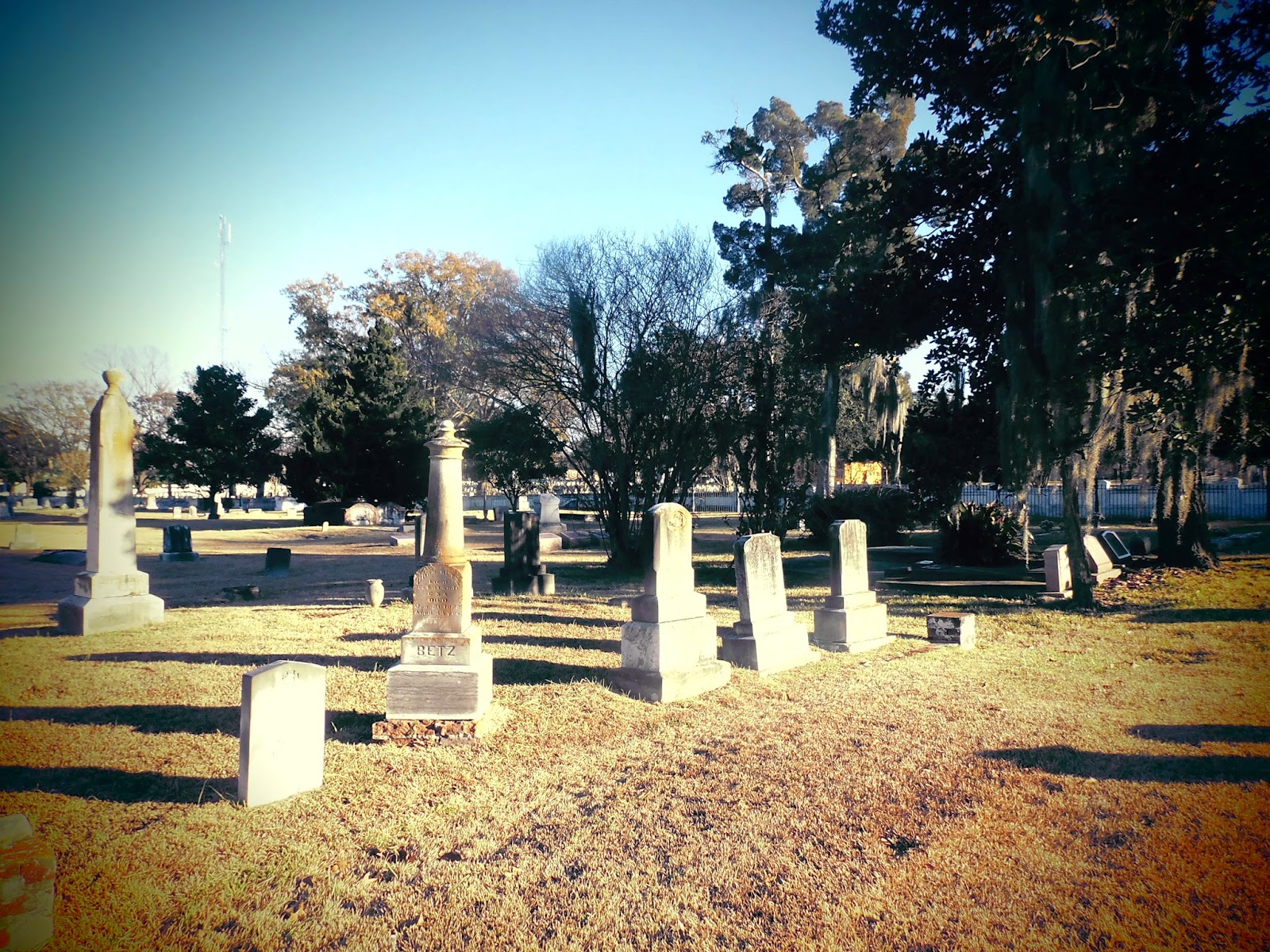
Let's take a walk at the cemetery

Since Halloween is approaching, let's put ourselves in the mood... I don't know about you, but for me, walking around in an old american cemetery brings back a lot of memories about american series or movies I watched during my teenage years. It just doesn't look like the ones in France. I must have watched Buffy a little too much. The old tombstones are not straight, a lot of them don't have a base, grass grows on nameless empty plots, as a result alleys look very unorganized, it gives it a spooky feeling, but I find it all rather pretty. 

Here is one of the oldest cemetery in Baton Rouge: Magnolia Cemetery. 


It is a national historic site, where a lot of local personalities are buried. It was  the site of intense fights during the Battle of Baton Rouge on August 5, 1862. Union soldiers were camped on the west side of the cemetery, and the Confederates to the East. 
When the battle started, the northern forces were directed towards the Mississippi levee (to the west), because the Confederate army was waiting for relief from a battleship gunboat coming from Vicksburg (located further up the river in the State of Mississippi). Unfortunately for the South, the boat's engine broke down several time between Vicksburg and Baton Rouge, and eventually had to be destroyed by its own crew, in order to not be taken by the Union. It was blown up close to where Huey Long's bridge now crosses the Mississippi, just north of Baton Rouge. On the ground, the Union soldiers were then able to block the Confederates and push them to retreat. 


During the battle, tumbstones served as cover from bullets and bombs. One can still see traces of it on some stones or trees. The cemetery has a common grave filled with Confederate soldiers who fell during the battle. They were all buried on site. Union soldiers who died during the battle were transported out of the battle field and buried individually in what is now a federal cemetery, right accross the street. That cemetery looks much cleaner by the way: rows of neat white little stones typical of a military cemetery. 

Baton Rouge has grown a lot since then and now the cemetery is in the center of the urbanized area, between Florida Boulevard and Main Street. It's all ugly around, but the cemetery makes almost for a pretty public park, with big oaks, and old stones.  


Monday, September 15, 2014

New Orleans Red Dress Run!

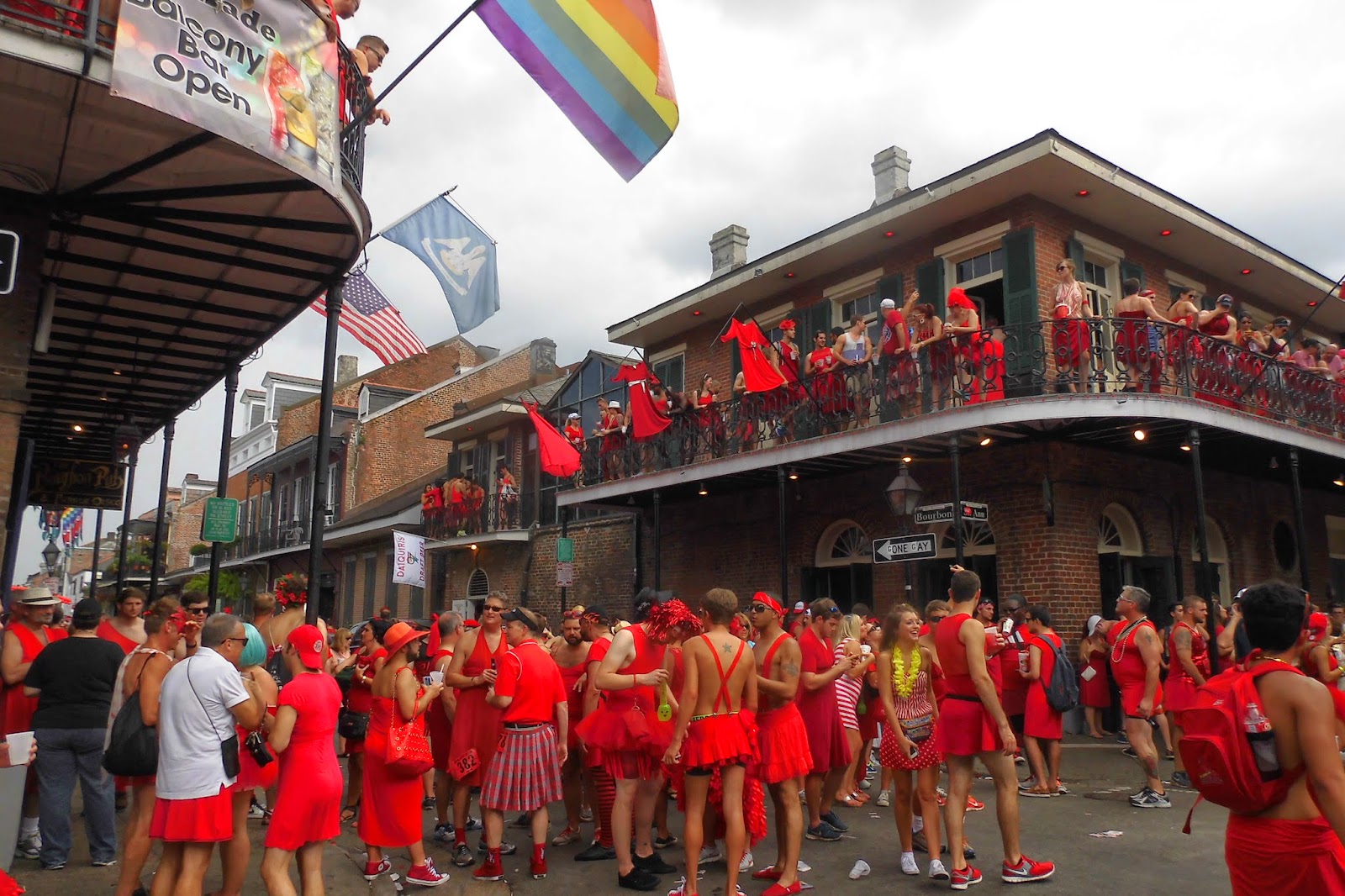
It was last month, in the seeping heat of August: New Orleans Red Dress Run. An annual event organized to gather funds for charities. It's fair to suspect that they don't only run, of course. Truthfully many don't run at all, but join the party in the French Quarter. It's yet another occasion for Bourbon Street to get filled with party-goers, but this time, all of them in red dresses!

Bourbon Street

How did Red Dress Run start? 

The Hash House Harriers are the biggest running club in the world. Their first red dress run happened nearly by accident: On August 7, 1987, a young lady wearing a red dress is arriving in southern California to visit a high school friend. She ends up shortly after in Long Beach, where her friend intends to introduce her to this zany running group called the Hash House Harriers. One member, noting her gender and attire, urged that she “just wait in the truck” until her host returned. With that goading, she ran into history sporting her red dress and heels. 
One year later, to commemorate the event, the San Diego Hash House Harriers sent “The Lady In Red” an airline ticket to attend the inaugural Red Dress Run. Hundreds of male and female hashers adorned themselves in red dresses for a spectacle widely covered by California newspapers and TV news. In addressing the crowd, The Lady In Red suggested that Hash House Harriers hold the Red Dress Run annually as an occasion be used to raise funds for local charities.
This tradition quickly spread to every corner of the globe. The New Orleans Hash House Harriers attracted 7,000 participants to their Red Dress Run in 2010, raising more than $200,000 for local charities.


Our group of cheerful chaps joined the crowd late in the morning. French quarter bars, sidewalks, and streets are packed. It's very hot, and very humid, and everybody starts dripping sweat very quickly, even without running. People, young and old, drink and dance inside and out. For those who know, this could compare to the southwestern France Feria. By the late afternoon we all are worn out, a good nap is a must, in order to make it to round 2 later that evening. Most friends in our group are staying in hotel rooms to not have to drive back to Baton Rouge. I now have my "second home" on site, even better... I ended up napping until the next morning. Verdict: partying is getting harder and harder these days... 


Wednesday, August 13, 2014

Tubing


It's summer, and it's hot. Very hot. In Louisiana, summer temperatures fluctuate between  90 and 95 degres and do not go below 70 at night. On top of it humidity levels are between 70 and 90 (= 90% moisture in the air), which means felt temperatures are easily 5 degrees over the real temperature. So actually we spend summer avoiding the sun and live with the AC. 

There's something I learnt since I've moved here, it's that when humidity climbs above 40 percent, the damp air makes any temperature over 80 degrees Fahrenheit feel hotter than what the thermometer actually reads. Sorry, I'm showing off my knowledge here, after all we never ask ourselves questions about heat effects in Paris... 

So in Louisiana, additionally, we have neither pretty beaches, nor mountain lakes and rivers, nor other normal places to spend summer vacations. However, we have a lot of brownish rivers that don't flow very fast. Among others, Amite river and Bogue Chitto. So what do we do to cool down?! We float down the rivers ass inside a rubber ring. Here they call that Tubing!


A tubing day: 

Upon arrival, everybody pay for its tube and, if needed (but very much recommended), for an additional tube to put the ice chest on. (Do not forget to bring your own ice chest). We leave all our stuff in the car: towels, clothes, which we won't need until we come back. Then we jump into a shuttle, often an old beat up yellow school bus, to reach to launching spot located upstream. We choose our tubes, and before to get in the water, we tie them one to another with a long rope. We are not towed by a boat, it is not a thrill ride... The goal is only to let yourselves go with the flow during approximately 4 hours, hat on the head and beer in hands. Pretty much a floating pic nic... (Attention, glass bottles are forbidden). And we stop once in a while on the sand beaches along the river. We can swim, play freezbee, ball, or whatever. 


Of course, at all times the risk is to come accross some creatures like snakes, alligators, giant spiders and other lovely Louisiana residents. So the advice is, if possible, to avoid floating under tree branches that are in the way on the river banks. Sometimes you don't really have a choice (or we were just not good at it), but you'll certainly collect unwanted stuff on your way. In reality it is very not likely to come accross an alligator. They rather live in swamp's stagnant water. I've never seen snakes either, either in Amite or in Bogue Chitto.


Aside from these little hazards, that were more fun than anything in the end, it is a very pleasant experience. Especially when the place is not packed with drunk, loud, obnoxious people. We sometimes meet some annoying individuals, but also nice local folks. 

With this, it's a little late, but happy summer anyway! But most importantly, bring on the fall! 


Friday, May 2, 2014

Rodeo at the Penitentiary!

Matt Mayfield Photography
Welcome to Angola, the Louisiana State Penitentiary, the largest maximum security prison in the United States. Yes... No less. That makes you dream doesn't it? It's also the only prison in Louisiana authorized to apply death penalty. We  are an hour and fifteen minutes north of Baton Rouge, surrounded on three sides by the Mississippi and on the other side by a forest plagued with snakes. 

In the past the site was a plantation where most of the slaves were from Angola, in Africa. Then at the end of the 19th, beginning of the 20th century, the State of Louisiana purchased a number of those plantations to convert them in penitentiaries. Prisoners continued to harvest the same kind of culture, mainly cotton and sugar cane. 

Dreadful fact, Louisiana imprisons more people than any nation in the world... 
In the early 1990's, Louisiane was ordered by the Federal Court to decrease the inmates overcrowding in State prisons. Because the State didn't have money, The Department of Corrections encouraged local Sheriffs and private companies to build new prisons by allowing them to receive part of the profit that will be generated. The whole thing became a business. There are today 160 local prisons (vs 12 State prisons). The State pays Sheriffs about $25 per day and per inmate. Which means that there's not much left after paying for food, lodging and personnel costs. Profit is used to buy patrol cars, fire arms, bulletproof vests, etc... And of course, there is nothing left to finance programs that would be beneficial to prisoners. In short, if the number of inmates decreases, the Sheriff's office makes less money. Lobbies make sure to scuttle any reform that would result in less criminals behind bars. Half of the prisoners in Louisiana are incarcerated in local prisons, when there was only a quarter in the early 1990's. They are often transferred from  a prison to another to fill the gaps and make sure everybody make as much money as possible, and without getting any opportunities for rehabilitation, which you can imagine, doesn't reduce their chance to reoffend. Only State prisons offer programs to learn mechanic, welding, plumbing and other useful trades. But State prisons only receive the worse offenders, who, often, will never be set free. How absurd...  

Louisiana is one of the six States where life sentences are given without parole. Sentences are much heavier than elsewhere. An armed robbery or a trio of drug convictions can be enough to land you at Angola for the rest of your life. A two time car burglar can get 24 years without parole. Local prisons, that have proliferated in rural areas, are full of people who have been sentenced for non violent crimes such as drug possession, theft, or simply writing bad checks. And while prison population doubled, New Orleans still leads the nation in number of homicides. To make it short, this is a revolting clusterfuck!  

With this sad and alarming observation, let's get back to our Angola rodeo... 

AP Photos/Gerald Herbert
At Angola prison, you'll find the worse convicts, murderers, rapists and other people condemned to very long sentences. There are over 5000 prisonners and more than three quarters of them are serving life sentences or heavy sentences that will keep them in there all their life. It's the highest ratio of life sentences in the United States.  

Every sundays in October and the third sunday of April, the prison organizes a rodeo and a craft fair. Prisonners that prove fit enough to compete can participate if they want, and others sell their art to the public. Depending on the level of trust they gained, they sell their stuff either directly behind their booth, mingling freely with visitors, or behind a fence, with their goods laid on a table on your side of the fence. There are a lot of sculptures, wooden furniture and toys, paintings, jewelry, leather objects, etc... Wandering among prisoners feels wierd to me. Nonetheless I ended up buying a very beautiful raw wood vase, signed by the artist. A friend asked me later if I had googled the name of the guy to see why he was incarcerated... That's something you could do... or not...  

AP Photos/Gerald Herbert
During two hours inmates participate to several games. For example, the hula hoop challenge is about being the last man standing in his hula hoop without getting knocked down by the bull. For the Poker game, four prisoners are sitting at a table playing cards, until the bull is released in the arena and takes everything apart. There are also the classic riding competition of bucking horses and bulls. It's a hard enough challenge for rodeo professionals, so I cannot imagine what it's like for people with no training... Lots of them get hurt. Their motivation: small prizes to win: money, a steak dinner, belt buckles, or an article in the prison magazine. 

AP Photos/Gerald Herbert

Here the goal was to catch the red thingy between the bull's horns...
AP Photos/Gerald Herbert
Advocate Photo/Mark H. Hunter
This year, the revenues from the rodeo were estimated to 4 millions dollars. Profits are reinvested in services such as education programs for the inmates. 
Fyi, it is forbidden to bring your camera of phone inside the prison. Everything has to be left in your car. Though I've seen several people using their phones anyway. I'm a little pissed I wasn't able to take photos.

AP Photos/Gerald Herbert


Thursday, March 6, 2014

Happy Mardi Gras!


Mardi Gras History
It's because of the french and spanish catholic influences that Mardi Gras is celebrated in the southern states of the US. New Orleans is the most well-known place to celebrate it but there are the same traditions in cities of Alabama, Mississippi, and all the way to Pensacola, Florida. On March 2, 1699, the day before Mardi Gras, French-Canadian explorer Jean Baptiste Le Moyne Sieur de Bienville arrived at a plot of ground 60 miles directly south of New Orleans, and named it "Pointe du Mardi Gras". He established New Orleans in 1718, and by the 1730s, Mardi Gras was celebrated openly in the city. In the early 1740s, Louisiana's governor, the Marquis de Vaudreuil, established elegant society balls, which became the model for the New Orleans Mardi Gras balls of today. The earliest reference to Mardi Gras "Carnival" appears in 1781. That year, the first of hundreds of clubs and carnival organizations formed in New Orleans. By the late 1830s, New Orleans held street processions of maskers with carriages and horseback riders to celebrate Mardi Gras. The two first Krewe were formed in 1856 and 1870. In 1872, to  honor a visiting Russian Duke, a group of businessmen introduced his family's colors, purple, green and gold as Carnival's official colors. In 1875, the Governor signed the "Mardi Gras Act," making Fat Tuesday a legal holiday in Louisiana, which it still is. Like the first krewes, most Mardi Gras krewes today developed from private social clubs with restrictive membership policies. All the parade organizations are completely funded by their members. So bascially it's way cool to have the opportunity to ride a float and throw beads to everybody else! All kind of other knick-knacks are also thrown to the kids. 


Parades start weeks before Mardi Gras. New Orleans is primarily well-know for its Endymion and Bacchus parades on saturday and sunday before Mardi Gras. Themes vary from a city to the other and year after year. Here in Baton Rouge, the main parade, much smaller than any New Orleans parade, takes place in the historic neighborhood of Spanish Town. Krewe members do not really wear masks or costumes like in other parades, but the rose color is a must for everybody. A few weeks before Mardi Gras, the carnaval organizers go, by night, to put up about a hundred wooden flamingos in the middle of the university lake. During the following days, Baton Rouge people turn up with small boats to adopt their own flamingo which they will proudly display on their porches or at their windows. As a result we can see flamingos everywhere on the front porches of this neighborhood's houses, all year long.


Mardi Gras in Cajun country
In rural villages around Lafayette, traditions are slightly different. The local event is called the "Courir de Mardi Gras". In cajun French it means the race of Mardi Gras, and it comes from old french rural rituals. Since it's the last day before Lent, the participants heartily eat and drink. The men of the village get out on horse backs in the morning, wearing costumes and masks to hide their identity, and go from house to house begging for ingredients to make the communal gumbo at the end of the day. Offerings go from an onion to a live chicken, which they'll have to catch. 
Personal advise: If you go see a Courir de Mardi Gras, make sure to have stuff to give away in your pockets in case one of them begs you to pass something... For lack of food for the Gumbo, a few coins, or a bottle of beer will do it. Otherwise you are taking the risk to have to get rid of something you didn't want to give, or to end up head upside down on their shoulders being spanked. I speak from experience. You have been warned, they are shameless...