Showing posts with label Parties. Show all posts

Monday, September 15, 2014

New Orleans Red Dress Run!

It was last month, in the seeping heat of August: New Orleans Red Dress Run. An annual event organized to gather funds for charities. It's fair to suspect that they don't only run, of course. Truthfully many don't run at all, but join the party in the French Quarter. It's yet another occasion for Bourbon Street to get filled with party-goers, but this time, all of them in red dresses!

Bourbon Street

How did Red Dress Run start? 

The Hash House Harriers are the biggest running club in the world. Their first red dress run happened nearly by accident: On August 7, 1987, a young lady wearing a red dress is arriving in southern California to visit a high school friend. She ends up shortly after in Long Beach, where her friend intends to introduce her to this zany running group called the Hash House Harriers. One member, noting her gender and attire, urged that she “just wait in the truck” until her host returned. With that goading, she ran into history sporting her red dress and heels. 
One year later, to commemorate the event, the San Diego Hash House Harriers sent “The Lady In Red” an airline ticket to attend the inaugural Red Dress Run. Hundreds of male and female hashers adorned themselves in red dresses for a spectacle widely covered by California newspapers and TV news. In addressing the crowd, The Lady In Red suggested that Hash House Harriers hold the Red Dress Run annually as an occasion be used to raise funds for local charities.
This tradition quickly spread to every corner of the globe. The New Orleans Hash House Harriers attracted 7,000 participants to their Red Dress Run in 2010, raising more than $200,000 for local charities.
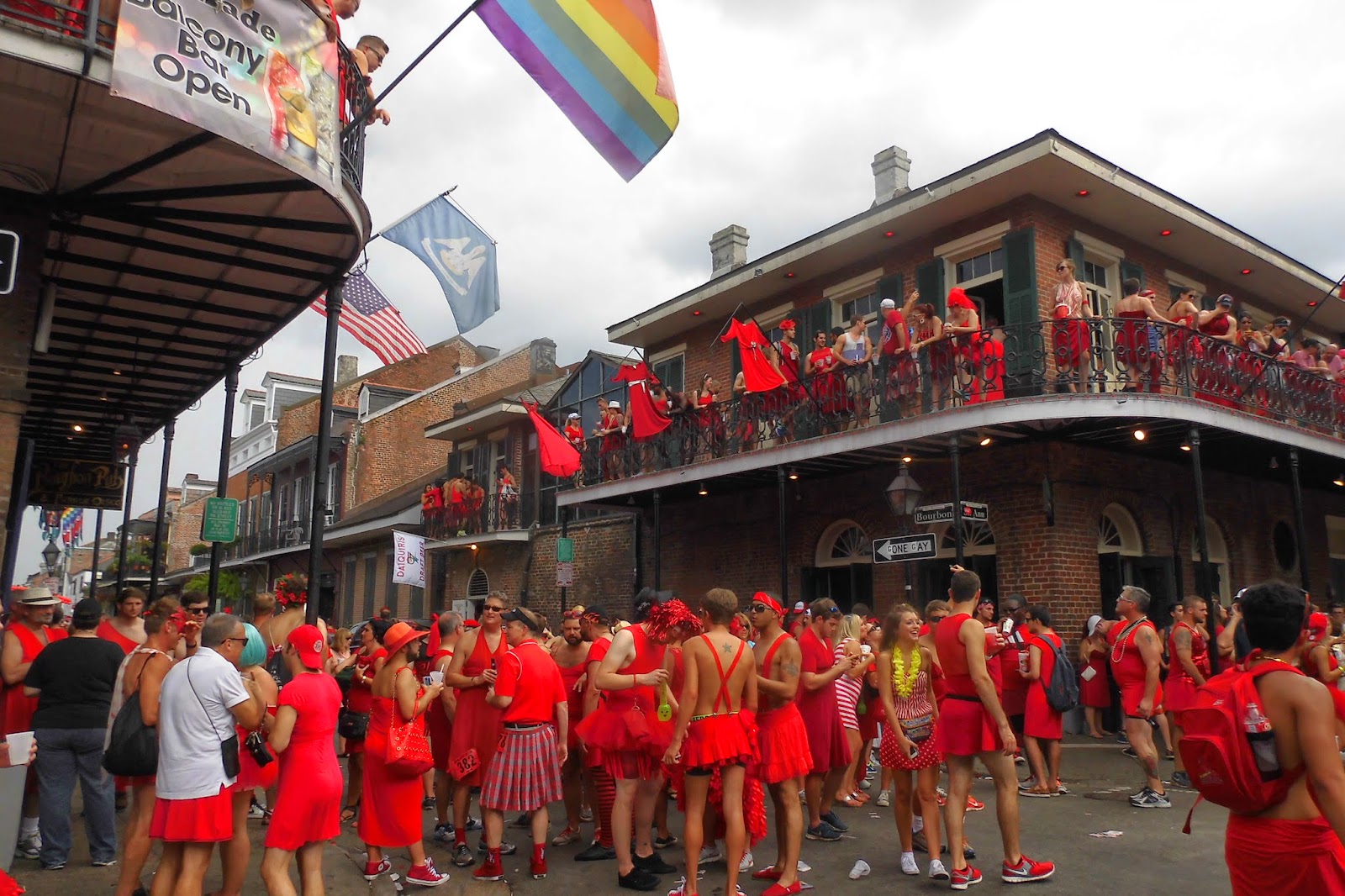


Our group of cheerful chaps joined the crowd late in the morning. French quarter bars, sidewalks, and streets are packed. It's very hot, and very humid, and everybody starts dripping sweat very quickly, even without running. People, young and old, drink and dance inside and out. For those who know, this could compare to the southwestern France Feria. By the late afternoon we all are worn out, a good nap is a must, in order to make it to round 2 later that evening. Most friends in our group are staying in hotel rooms to not have to drive back to Baton Rouge. I now have my "second home" on site, even better... I ended up napping until the next morning. Verdict: partying is getting harder and harder these days... 


Wednesday, August 13, 2014

Tubing


It's summer, and it's hot. Very hot. In Louisiana, summer temperatures fluctuate between  90 and 95 degres and do not go below 70 at night. On top of it humidity levels are between 70 and 90 (= 90% moisture in the air), which means felt temperatures are easily 5 degrees over the real temperature. So actually we spend summer avoiding the sun and live with the AC. 

There's something I learnt since I've moved here, it's that when humidity climbs above 40 percent, the damp air makes any temperature over 80 degrees Fahrenheit feel hotter than what the thermometer actually reads. Sorry, I'm showing off my knowledge here, after all we never ask ourselves questions about heat effects in Paris... 

So in Louisiana, additionally, we have neither pretty beaches, nor mountain lakes and rivers, nor other normal places to spend summer vacations. However, we have a lot of brownish rivers that don't flow very fast. Among others, Amite river and Bogue Chitto. So what do we do to cool down?! We float down the rivers ass inside a rubber ring. Here they call that Tubing!


A tubing day: 

Upon arrival, everybody pay for its tube and, if needed (but very much recommended), for an additional tube to put the ice chest on. (Do not forget to bring your own ice chest). We leave all our stuff in the car: towels, clothes, which we won't need until we come back. Then we jump into a shuttle, often an old beat up yellow school bus, to reach to launching spot located upstream. We choose our tubes, and before to get in the water, we tie them one to another with a long rope. We are not towed by a boat, it is not a thrill ride... The goal is only to let yourselves go with the flow during approximately 4 hours, hat on the head and beer in hands. Pretty much a floating pic nic... (Attention, glass bottles are forbidden). And we stop once in a while on the sand beaches along the river. We can swim, play freezbee, ball, or whatever. 


Of course, at all times the risk is to come accross some creatures like snakes, alligators, giant spiders and other lovely Louisiana residents. So the advice is, if possible, to avoid floating under tree branches that are in the way on the river banks. Sometimes you don't really have a choice (or we were just not good at it), but you'll certainly collect unwanted stuff on your way. In reality it is very not likely to come accross an alligator. They rather live in swamp's stagnant water. I've never seen snakes either, either in Amite or in Bogue Chitto.


Aside from these little hazards, that were more fun than anything in the end, it is a very pleasant experience. Especially when the place is not packed with drunk, loud, obnoxious people. We sometimes meet some annoying individuals, but also nice local folks. 

With this, it's a little late, but happy summer anyway! But most importantly, bring on the fall! 


Thursday, March 6, 2014

Happy Mardi Gras!


Mardi Gras History
It's because of the french and spanish catholic influences that Mardi Gras is celebrated in the southern states of the US. New Orleans is the most well-known place to celebrate it but there are the same traditions in cities of Alabama, Mississippi, and all the way to Pensacola, Florida. On March 2, 1699, the day before Mardi Gras, French-Canadian explorer Jean Baptiste Le Moyne Sieur de Bienville arrived at a plot of ground 60 miles directly south of New Orleans, and named it "Pointe du Mardi Gras". He established New Orleans in 1718, and by the 1730s, Mardi Gras was celebrated openly in the city. In the early 1740s, Louisiana's governor, the Marquis de Vaudreuil, established elegant society balls, which became the model for the New Orleans Mardi Gras balls of today. The earliest reference to Mardi Gras "Carnival" appears in 1781. That year, the first of hundreds of clubs and carnival organizations formed in New Orleans. By the late 1830s, New Orleans held street processions of maskers with carriages and horseback riders to celebrate Mardi Gras. The two first Krewe were formed in 1856 and 1870. In 1872, to  honor a visiting Russian Duke, a group of businessmen introduced his family's colors, purple, green and gold as Carnival's official colors. In 1875, the Governor signed the "Mardi Gras Act," making Fat Tuesday a legal holiday in Louisiana, which it still is. Like the first krewes, most Mardi Gras krewes today developed from private social clubs with restrictive membership policies. All the parade organizations are completely funded by their members. So bascially it's way cool to have the opportunity to ride a float and throw beads to everybody else! All kind of other knick-knacks are also thrown to the kids. 


Parades start weeks before Mardi Gras. New Orleans is primarily well-know for its Endymion and Bacchus parades on saturday and sunday before Mardi Gras. Themes vary from a city to the other and year after year. Here in Baton Rouge, the main parade, much smaller than any New Orleans parade, takes place in the historic neighborhood of Spanish Town. Krewe members do not really wear masks or costumes like in other parades, but the rose color is a must for everybody. A few weeks before Mardi Gras, the carnaval organizers go, by night, to put up about a hundred wooden flamingos in the middle of the university lake. During the following days, Baton Rouge people turn up with small boats to adopt their own flamingo which they will proudly display on their porches or at their windows. As a result we can see flamingos everywhere on the front porches of this neighborhood's houses, all year long.


Mardi Gras in Cajun country
In rural villages around Lafayette, traditions are slightly different. The local event is called the "Courir de Mardi Gras". In cajun French it means the race of Mardi Gras, and it comes from old french rural rituals. Since it's the last day before Lent, the participants heartily eat and drink. The men of the village get out on horse backs in the morning, wearing costumes and masks to hide their identity, and go from house to house begging for ingredients to make the communal gumbo at the end of the day. Offerings go from an onion to a live chicken, which they'll have to catch. 
Personal advise: If you go see a Courir de Mardi Gras, make sure to have stuff to give away in your pockets in case one of them begs you to pass something... For lack of food for the Gumbo, a few coins, or a bottle of beer will do it. Otherwise you are taking the risk to have to get rid of something you didn't want to give, or to end up head upside down on their shoulders being spanked. I speak from experience. You have been warned, they are shameless...

Tuesday, November 5, 2013

Halloween

Halloween... you can feel it coming as soon as stores shelves are emptied of their back to school supplies... 2 months ahead. When shopping, it's impossible to miss the assortment of pumpkin scented candles, plush scarecrows and other lovely cheesy objects.

I made a list of this holiday's activities for my french folks: 

The Pumpkin Patch
In October, people start buying pumpkins in supermarkets or the few pumpkin patches that open here and there for the season. Most of the time, pumpkins have already been picked and laid on a field for people to conveniently choose from. There's often children activities proposed such as hay ride and petting zoo. Depending on what you want to do with it, you can choose from all sort of funny looking pumpkins: big, small, orange, white, etc... Little gourds are often used as decoration, and big ones will end up in front of the house before Halloween night.

Here are a few pictures from an afternoon spent at Ernie and Lynda's farm in Amite. Most pumpkins were already picked up. The "real" field was rather impracticable. Sorry for the power transmission line in the pic... not super glam, I know.


Pumpkin Carving
Then comes the time to carve... The trick here in Louisiana is to not do so too early so the pumpkins don't rot before the 31st. More than 3 days outside and you already have mold and flies all over them. It gets gross pretty quickly.
You can carve scary, funny or just cute little pumpkins. The famous Jack O'Lantern is the standard, but really there's no more standard, people carve whatever they want: spiders, bats, witches, etc...

Some cool pumpkins seen in magazines:


And in front of my house!:


The Corn Maze
Another pre Halloween activity: corn mazes. You have the child-friendly version during the day, and the haunted version at night, where dressed up kids and adults enjoy wholeheartedly freaking you out at each dark corner of the maze. Those pics are not mine. We made the trip one evening to the Cajun Country Corn Maze, the closest from here, and we never found it. Fail. Apparently, it wasn't open this year. Huge disappointment. I had never been to one and was looking forward to this. But well, I had to illustrate it anyway:


The Haunted House
Along the same lines, there's the whole array of haunted houses, from the kid friendly ones to the seriously scary ones. As it happens, we have here in Baton Rouge, the 13th Gate Haunted House, one of the best in the US, from what I've read in an article. Not for the faint hearted. I will quote the words of a couple of french friends that tested it for you: "We flipped the fuck out! The set is incredibly well done, very dark, actors do an amazing job playing scenes from The Chainsaw massacre to Jack the Riper via The Exorcist... Almost an hour in the dark without knowing what will jump in your face!" Anyway, I, personally, am too much of a sissy to try it out but I can confirm that there was a huge line in front of the building every week end since early October. 


From early October or even earlier, some people start to plan their Halloween costume. Everybody doesn't necessarily put much passion and effort into this. As far as I'm concerned, the last four years were rather boring, but this time, we did it right. Too many years of barely knowing what Halloween was about! It was nice to catch up! We spent the week end in New Orleans at a friend's house. A whole lot of tourists flock to the city for Halloween. To begin with, New Orleans already has a reputation for parties and creepy mystical stuff, so both together, it has to attract people! It is almost impossible to find a hotel room available for that week end. If you do find one, get ready to shell out $400.


"Trick or Treat"
October 31st: This year I was full on. I wanted to properly welcome the little monsters who would come knock at my door: My 4 or 5 pumpkins lit up on the porch, my little ghosts hanging from a branch, some candy... Tough luck, it rained all evening. Nobody came. So we headed to the bar, where the rain didn't ruin the party!


Friday, October 25, 2013

Lafayette Cajun Festival

A couple weeks ago I went to the Festival Acadiens and Creoles in Lafayette to listen to some cajun music and Zydeco and eat good cajun and creole food. Lovely afternoon.


For those who don't know, who are the Cajuns?


"Acadians, or Cajuns as they are now called, were exiled from Nova Scotia in 1755. They carried away a rich cultural heritage, which included a blend of French, Celtic, Scots-Irish and Native American influences. This mixture is evident in a rich oral tradition and repertoire of songs and dances. By the turn of the twentieth century, increasing homogenization of the United States threatened to doom the French language to obscurity. Early versions of the Louisiana constitution made valiant attempts to legitimize the use of French, but America charged on with the nationalism movement. The approach of World War I induced a quest for national unity, which suppressed regional diversity.
In 1916, mandatory English language education was made available to the rest of Louisiana and was imposed in the South. French was trampled in a frontal assault on illiteracy. Several generations of Cajuns and Créoles were eventually convinced that speaking french was a sign of cultural illegitimacy. In the late 1940's the tide seemed to turn. Soldiers in France during World War II discovered that the language and culture they had been told to forget made them invaluable as interpreters and made surviving generally easier. After the war, returning GI's immersed themselves in their own culture. Dance halls throughout South Louisiana once again blared the familiar and comforting sounds of homemade music. 
In 1968, the State of Louisiana officially recognized the Cajun cultural revival by creating the Council for the Development of French in Louisiana (CODOFIL). CODOFIL began its efforts on political, psychological and educational fronts to erase the stigma Louisianans had long attached to the French language and culture. In addition to creating French classes in elementary schools, CODOFIL organized the first Tribute to Cajun Music Festival in 1974."

My own video didn't want to load, so I am showing here a video found online from a previous year. I chose it because you can hear them talk and sing in French. A very particular kind of French obviously. It is almost impossible for me to understand anything when they sing it...


Zydeco dancing:


You think those two are happy to dance?


Bringing your own couch to the event seem to be the thing to do

Little girl playing in the mud 


Of course the best local restaurants and caterers prepare their specialties. You can go from one booth to another and taste all those yummy local dishes:

Soft-shell crab - crab cooked when it's molting. Its shell isn't hard, so you can it it all. 
 
Boudin - Cajun boudin is a sausage stuffed with porc, rice, a mix of onion, bellpeppers, celeri and spices. Nothing to do with our french boudin (blood sausage).

Crawfish étouffée 
 

Corn and crab bisque - Creamy soup with crab, corn, onions, celeri and garlic.
 

Meat pies - Little pies stuffed with ground beef, porc, onions, garlic, peppers and cayenne pepper. 
 

Catfish courtbouillon - Catfish stew
 

Alligator sausage poboy 
 

Shrimp jambalaya 


Craklins - fried porc rind


Oddly I'm getting hungry now. After five years in this country I surprisingly haven't gained any weight, but if that changes you'll know why...